#include <stdio.h>#include <stdlib.h>#include <errno.h>#include <getopt.h>#include <sys/types.h>#include <sys/socket.h>#include <netinet/in.h>#include <net/if.h>#include <arpa/inet.h>#include <fcntl.h>#include <poll.h>#include <string.h>#include <math.h>#include <netdb.h>#include <time.h>
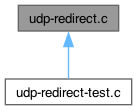
Go to the source code of this file.
Classes | |
| struct | settings |
| struct | statistics |
Macros | |
| #define | UDP_REDIRECT_VERSION "2.2.0" |
| #define | STATISTICS_DELAY_SECONDS 60 |
| #define | NETWORK_BUFFER_SIZE 65535 |
| #define | EOK 0 |
| Readability: errno value for OK. | |
| #define | MAX_ERRNO 256 |
| #define | ERRNO_IGNORE_INIT(X) |
| #define | ERRNO_IGNORE_SET(X, Y) |
| #define | ERRNO_IGNORE_CHECK(X, Y) |
| #define | PARSE_PORT(src, dest, label) |
| #define | DEBUG(debug_level_local, debug_level_message, fmt, ...) |
| #define | HUMAN_READABLE_FORMAT "%.1lf%c" |
| #define | HRF HUMAN_READABLE_FORMAT |
| #define | HUMAN_READABLE(X) |
| #define | HUMAN_READABLE_SIZES { ' ', 'K', 'M', 'G', 'T', 'P', 'E' } |
| #define | HUMAN_READABLE_SIZES_COUNT 7 |
Enumerations | |
| enum | DEBUG_LEVEL { DEBUG_LEVEL_ERROR = 0 , DEBUG_LEVEL_INFO = 1 , DEBUG_LEVEL_VERBOSE = 2 , DEBUG_LEVEL_DEBUG = 3 } |
| The available debug levels. More... | |
Functions | |
| static int | socket_setup (const int debug_level, const char *desc, const char *xaddr, const int xport, const char *xif, int xfamily, struct sockaddr_storage *xsock_name) |
| static char * | resolve_host (int debug_level, const char *host) |
| static int | parse_addr (const char *str, int port, struct sockaddr_storage *out) |
| static const char * | addr_tostring (const struct sockaddr_storage *sa, char *buf, size_t len) |
| static int | addr_port (const struct sockaddr_storage *sa) |
| static socklen_t | addr_len (const struct sockaddr_storage *sa) |
| static int | addr_is_unset (const struct sockaddr_storage *sa) |
| static int | addr_equal (const struct sockaddr_storage *a, const struct sockaddr_storage *b) |
| void | settings_initialize (struct settings *s) |
| void | usage (const char *argv0, const char *message) |
| void | statistics_initialize (struct statistics *st) |
| double | int_to_human_value (double value) |
| char | int_to_human_char (double value) |
| void | statistics_display (int debug_level, struct statistics *st, time_t now) |
| int | main (int argc, char *argv[]) |
| static double | int_to_human_scale (double value, int *count_out) |
Variables | |
| static struct option | longopts [] |
Detailed Description
- Version
- 2.2.0
LICENSE
This program is free software; you can redistribute it and/or modify it under the terms of the GNU General Public License as published by the Free Software Foundation; either version 2 of the License, or (at your option) any later version.
DESCRIPTION
A single-file, high-performance UDP packet redirector supporting IPv4 and IPv6. Useful when layer-level redirection (e.g., firewall rules) is impractical — common use cases include Wireguard VPN, DNS, and game servers.
Design overview:
- Two non-blocking UDP sockets: a listen socket (faces the local client) and a send socket (faces the remote endpoint).
- A poll(2)-based main loop with a 1-second timeout drives all I/O; no threads or dynamic allocation occur inside the loop.
- Packets arriving on the listen socket are forwarded to the connect endpoint; replies arriving on the send socket are forwarded back to the most-recently-seen listen-side source.
- Optional strict-mode flags limit which sources are accepted on each side.
- Optional 60-second windowed statistics are printed to stderr.
Targets: Linux x86-64 and macOS/Darwin arm64.
Macro Definition Documentation
◆ DEBUG
| #define DEBUG | ( | debug_level_local, | |
| debug_level_message, | |||
| fmt, | |||
| ... ) |
Standard debug macro requiring a locally defined debug level. Adapted from the excellent https://github.com/jleffler/soq/blob/master/src/libsoq/debug.h
Note that VA_ARGS is a GCC extension; used for convenience to support DEBUG without format arguments.
◆ EOK
| #define EOK 0 |
Readability: errno value for OK.
◆ ERRNO_IGNORE_CHECK
| #define ERRNO_IGNORE_CHECK | ( | X, | |
| Y ) |
◆ ERRNO_IGNORE_INIT
| #define ERRNO_IGNORE_INIT | ( | X | ) |
Initialize errno ignore set
◆ ERRNO_IGNORE_SET
| #define ERRNO_IGNORE_SET | ( | X, | |
| Y ) |
Set errno ignore boolean for a specific errno
◆ HRF
| #define HRF HUMAN_READABLE_FORMAT |
Shortcut for the above, for shorter printf
◆ HUMAN_READABLE
| #define HUMAN_READABLE | ( | X | ) |
Hardcoded invocations of int to human readable, compatible with HUMAN_READABLE_FORMAT in printf
◆ HUMAN_READABLE_FORMAT
| #define HUMAN_READABLE_FORMAT "%.1lf%c" |
Hardcoded printf format for a human readable value made of a float and a char
◆ HUMAN_READABLE_SIZES
| #define HUMAN_READABLE_SIZES { ' ', 'K', 'M', 'G', 'T', 'P', 'E' } |
The human readable size suffixes
◆ HUMAN_READABLE_SIZES_COUNT
| #define HUMAN_READABLE_SIZES_COUNT 7 |
The number of human readable size suffixes
◆ MAX_ERRNO
| #define MAX_ERRNO 256 |
Maximum known errno, used to ignore harmless sendto / recvfrom errors
◆ NETWORK_BUFFER_SIZE
| #define NETWORK_BUFFER_SIZE 65535 |
The size of the network buffer used for receiving / sending packets
◆ PARSE_PORT
| #define PARSE_PORT | ( | src, | |
| dest, | |||
| label ) |
Parse a port number from a string (optarg). Sets dest to the parsed value, or prints label and exits on error. Validates that the string is a pure decimal integer in [0, 65535].
◆ STATISTICS_DELAY_SECONDS
| #define STATISTICS_DELAY_SECONDS 60 |
The delay in seconds between displaying statistics
◆ UDP_REDIRECT_VERSION
| #define UDP_REDIRECT_VERSION "2.2.0" |
The udp-redirect version
Enumeration Type Documentation
◆ DEBUG_LEVEL
| enum DEBUG_LEVEL |
Function Documentation
◆ addr_equal()
|
static |
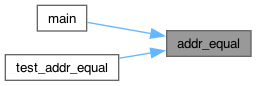
Return 1 if both sockaddr_storage values have the same family, address, and port.
◆ addr_is_unset()
|
static |
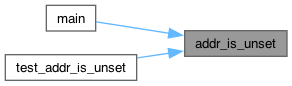
Return 1 if the address is the zero-initialised "unset" sentinel (ss_family == 0).
◆ addr_len()
|
static |
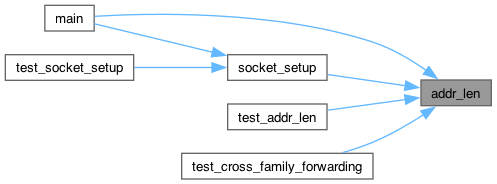
Return the wire size of a sockaddr_storage appropriate for its address family.
◆ addr_port()
|
static |
Return the port from a sockaddr_storage in host byte order.
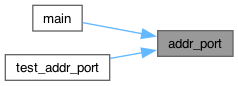
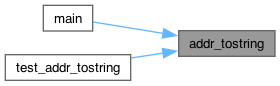
◆ addr_tostring()
|
static |
Format the address portion of a sockaddr_storage into buf using inet_ntop.
- Returns
- buf on success, "?" on failure.
◆ int_to_human_char()
| char int_to_human_char | ( | double | value | ) |
Convert a value to human readable (i.e., 1500 = 1.5K). Divide by 1000, not 1024.
- Parameters
-
[in] value The value to be converted
- Returns
- The character (K, M, G, etc.) portion of the human readable value.


◆ int_to_human_scale()
|
static |
Shared scaling helper: divides value by 1000 repeatedly until it is <= 1000 or the maximum prefix is reached.
- Parameters
-
[in] value The raw value to scale. [out] count_out The number of divisions performed (index into the human-readable suffix array).
- Returns
- The scaled value.

◆ int_to_human_value()
| double int_to_human_value | ( | double | value | ) |
Convert a value to human readable (i.e., 1500 = 1.5K). Divide by 1000, not 1024.
- Parameters
-
[in] value The value to be converted
- Returns
- The numeric portion of the human readable value.


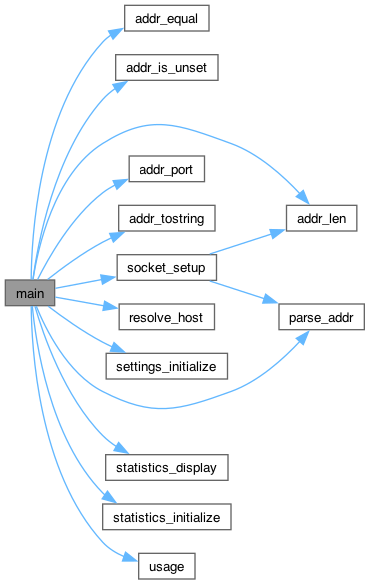
◆ main()
| int main | ( | int | argc, |
| char * | argv[] ) |
Main program function.
- Parameters
-
[in] argc The count of arguments, including the program name. [in] argv The program arguments
- Returns
- The program return code.
Accept the packet IF:
- There's no previous endpoint, OR
- There is a previous endpoint, but we are not in strict mode, OR
- The previous endpoint matches the current endpoint
Accept the packet IF:
- The listen socket has received a packet, so we know the endpoint, AND
- The packet was received from the connect endpoint, OR
- We are not in strict mode
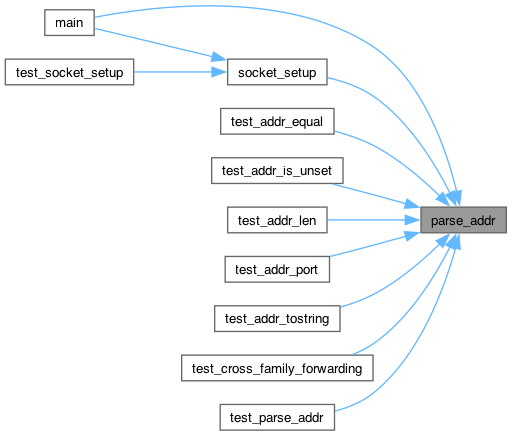
◆ parse_addr()
|
static |
Parse an IPv4 or IPv6 address string into a sockaddr_storage. Sets ss_family, the address field, and the port.
- Parameters
-
[in] str Dotted-quad IPv4 or colon-separated IPv6 address string. [in] port Port number in host byte order. [out] out Zeroed sockaddr_storage to fill.
- Returns
- AF_INET or AF_INET6 on success, -1 if the string is not a valid address.
◆ resolve_host()
|
static |
Resolve a host to an IP address.
- Parameters
-
[in] debug_level The debug level to be used for the DEBUG() macro [in] host The host to resolve
- Returns
- A newly heap-allocated NUL-terminated string containing the resolved IP address (IPv4 dotted-quad or IPv6 colon-separated). The caller owns the buffer and must free() it when done. On failure the function prints a diagnostic and calls exit(EXIT_FAILURE).

◆ settings_initialize()
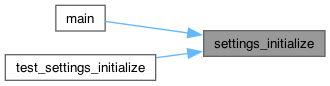
| void settings_initialize | ( | struct settings * | s | ) |
Initialize settings.
- Parameters
-
[out] s The settings structure to initialize.
◆ socket_setup()
|
static |
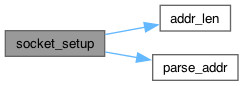
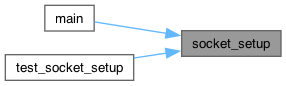
Creates a UDP socket on the specified address, port and interface, returning the socket and the socket name (if either arguments were NULL or 0).
- Parameters
-
[in] debug_level The debug level to be used for the DEBUG() macro [in] desc The caller description, added to debug messages [in] xaddr The address for the socket to be created, or NULL for ANY [in] xport The port for the socket to be created, or 0 for random (decided by bind()) [in] xif The OS interface name to bind to, or NULL for all interfaces. [in] xfamily AF_INET or AF_INET6; used only when xaddr is NULL. [out] xsock_name The name of the socket created.
- Returns
- The socket file descriptor as integer.
◆ statistics_display()
| void statistics_display | ( | int | debug_level, |
| struct statistics * | st, | ||
| time_t | now ) |
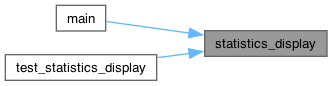
Display the stored statistics
- Parameters
-
[in] debug_level The debug level to be used for the DEBUG() macro [in] st The statistics structure [in] now The current time
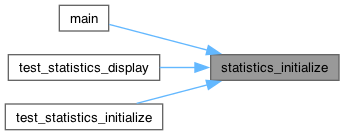
◆ statistics_initialize()
| void statistics_initialize | ( | struct statistics * | st | ) |
Initialize statistics.
- Parameters
-
[out] st The statistics structure to initialize.
◆ usage()
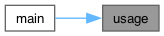
| void usage | ( | const char * | argv0, |
| const char * | message ) |
Displays the program usage and exit with error.
- Parameters
-
[in] argv0 The program name as started, e.g., /usr/local/bin/udp-redirect [in] message The error message, or NULL
Variable Documentation
◆ longopts
|
static |
Command line options.